
Last Updated on October 18, 2026
What Moon Phase Was I Born In?
Enter your birth date to find your birth moon phase instantly. No birth time or location needed.
You were born under a
Calculated for noon (UTC) on your birth date. If you were born close to a phase change, your result may differ by one phase. For reflection and entertainment.
Introduction
Your birth moon phase is the shape the Moon showed in the sky on the day you were born, and the calculator on this page finds yours from your birth date alone. The Moon travels through a 29.5 day moon cycle, which gets split into 8 moon phases that each cover 12.5% of the loop. You landed in one of them. It might be a dark new moon, a bright full moon, or any step in between. Discovering what moon phase was I born in takes only a few seconds, unlocking key insights into your emotional strengths and core personality.
Type in your birth date and you get your phase name, its moon illumination percentage, and a short moon phase meaning in seconds. Behind the scenes, the tool measures the angle between the Sun and the Moon at noon UTC on your birth date, then sorts that angle into one of the eight phases. Maybe a friend posted her phase online and now you want to know yours. Treat the result as a starting point: moon phases astrology reads your phase as a lens for self-reflection, not a scientific fact, and a 2024 study of 13,349 births at an Italian hospital found no link between moon phase and when babies are born.
What Moon Phase Was I Born In?
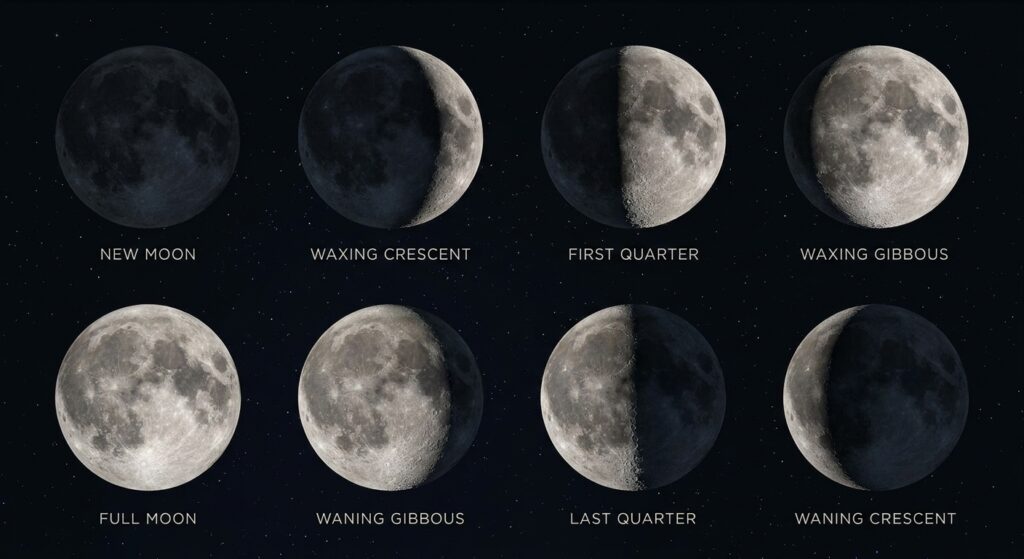
- New Moon
This is the phase where the Moon looks completely dark, with 0% moon illumination, because it sits directly between Earth and the Sun. Its sunlit side faces away from us, so you see nothing but sky. It kicks off the 8 moon phases, and every trip around starts from here. Think of a camping night when the stars look extra sharp and there is no Moon to spot. That is this phase doing its thing. Astrologers link it to fresh starts, though that part is symbolism, not science. - Waxing Crescent
A thin silver sliver of light shows on the right side of the Moon in this phase, and between 1% and 49% of its face is lit. If you ask which side of the moon is lit, the answer is the right side in the Northern Hemisphere, and it flips in the Southern Hemisphere. People also wonder what does waxing and waning mean. Waxing just means the lit part grows bigger each night. Look low in the western sky right after sunset and you can catch it. - First Quarter
This phase shows exactly half of the Moon’s face lit, or 50%, all on the right side. A moon age of about 7 days puts it 25% of the way through the 29.5 day moon cycle. The name trips people up, because “quarter” describes how far the Moon has traveled, not how much of it you see. And since the Moon’s orbit is not a perfect circle, the real timing shifts from month to month. - Waxing Gibbous
Between 51% and 99% of the Moon’s face is lit in this phase, all on the right side, so it looks nearly full. It is still a waxing moon, which means the glow keeps growing each night on the way to full brightness. It rises in the afternoon, so you can spot it in daylight before the stars come out. Many people mistake it for the brightest night of the month, but that comes one phase later. - Full Moon
The whole face of the Moon is lit, a full 100%, because our planet sits between the Moon and the sunlight. It lands about 14.8 days into the cycle, which is 50% of the way through. Picture a quiet street at night where you can read a sign without a flashlight. That is this phase at work. The Moon is truly full for just one moment, though it looks full for about 3 nights in a row. - Waning Gibbous
Between 99% and 51% of the Moon’s face is still lit in this phase, but the light starts shrinking on the right side. Waning means the visible light drops each night, the mirror image of the growing glow before full brightness. It rises after dark and stays up into the morning, so you can see it on a late walk or an early commute. - Last Quarter
Half of the Moon’s face is lit again, or 50%, but now the glow sits on the left side. It shows up about 22 days into the cycle, which is 75% of the way around. This is the early-cycle half moon flipped in a mirror. You can spot it in the morning sky around sunrise, while the coffee is still brewing. - Waning Crescent
Only a thin sliver of light remains on the left side of the Moon, and the lit part shrinks from 49% down toward 0%. It is the last stage of a waning moon, and it hands things back to the dark Moon so the cycle can start over. Catch it low in the eastern sky just before dawn, and give your eyes time to adjust, because the sliver fades fast.
What Does Your Birth Moon Phase Say About You?
| Moon phase | Core personality | Strengths | Challenges |
|---|---|---|---|
| New Moon | Instinctive initiator who starts things on a gut feeling | Courage, fresh ideas, self-trust | Can be hard to read, and may struggle to explain their plans |
| Waxing Crescent | Hopeful pusher who works against resistance to get going | Persistence, optimism, determination | Self-doubt early on, easily discouraged by slow progress |
| First Quarter | Decisive doer who is energized by challenges | Action, leadership, problem solving | Impatience, and a habit of pushing through when they should pause |
| Waxing Gibbous | Perfectionist who refines before sharing | Analysis, attention to detail, discipline | Overthinking, and holding work back until it feels “ready” |
| Full Moon | Expressive and people-aware, feels things openly | Charisma, empathy, emotional depth | Intensity, mood swings, taking things personally |
| Waning Gibbous | Generous teacher who shares what they learn | Wisdom, mentoring, gratitude | Giving too much and neglecting their own needs |
| Last Quarter | Questioner who rethinks old beliefs | Honesty, adaptability, willingness to change | Restlessness, and a tendency to feel stuck between old and new |
| Waning Crescent | Reflective old soul with strong intuition | Insight, calm, release of the past | Withdrawing from others, and a habit of underrating their own gifts |
Why Does Your Birth Moon Phase Matter?
Your phase matters in astrology because it points to your emotional needs and the rhythm you work in, like a rough map of how you start, build and finish things. Each moon phase meaning links to a stage in cycles of growth, from new beginnings to letting go and rest and renewal. That gives you words for habits you already notice.
Say you charge into new projects and then lose steam halfway. Reading your phase gives that pattern a name and a question to ask, and that kind of self-awareness is the real payoff. People also mix up moon sign vs moon phase: the phase describes how much of the Moon was lit when you were born, while the sign names where it sat in the zodiac, and both can be read from your birth chart.
Keep your expectations realistic. Astrology is not backed by scientific testing, so read the traits as prompts for reflection, not predictions. If births spread evenly across the cycle, about 12.5% of people share your phase, which is a good reason not to treat it as a verdict.
Moon Phase Compatibility: A Beginner’s Guide
Two phases interact by showing where each of you sits in the same 29.5 day moon cycle, and astrologers read the gap between those spots as a rough sign of how your rhythms fit. Phases close together share a pace. Phases on opposite sides, 50% of the cycle apart, are said to complete each other, the way a new moon and a full moon make one whole circle of light and shadow. That gap is the heart of moon phase compatibility.
Take a pair of friends where one starts every project and the other loves wrapping them up and resting. Reading their phases would put the first near the start of the cycle and the second near the end, which is the waxing vs waning moon split: building momentum versus sharing and releasing. Run both birth dates through the moon phase calculator to see where you each land. Keep it light, though. Astrologer Babs Cheung told Bustle that phases carry little weight in her compatibility readings. And if births spread evenly across the cycle, there is a 12.5% chance that a random pair share a phase and a 12.5% chance they land on opposite sides.
FAQ Section
Can two people have the same birth moon phase?
Yes. The Moon repeats its phases every 29.5 days, so anyone born on a similar point in the cycle shares your phase, even in a different year. If births spread evenly, about 12.5% of people share yours
Does moon phase change my zodiac sign?
No. Your zodiac sign comes from where the Sun was when you were born, while your moon phase describes how much of the Moon was lit. They are separate parts of your birth chart.
Is birth moon phase the same as moon sign?
No. The phase tells you how much of the Moon was lit, and the moon sign is the zodiac sign the Moon sat in. The Moon changes signs every 2 to 3 days, so you need your birth time to pin down the sign.
Do I need my birth time to find my birth moon phase?
No, your birth date is enough. If you were born right at the change between two phases, the result can differ by one phase. Your birth time matters more for your moon sign and full chart.
Conclusion
Your birth moon phase won’t decide your future, but it gives you a simple, thoughtful way to understand your own rhythm and how you connect with others. Find your phase with the calculator above, then check your moon phase compatibility with someone you care about →
