
Introduction
The moon phase vs zodiac sign difference comes down to timing. Your zodiac sign is fixed the moment you’re born, shaping steady personality traits that don’t change. Moon phases, though, shift every few days, carrying their own lunar energy that rises and falls with the current cycle. Picture a new moon landing during a hectic week—many people notice their emotions feel more sensitive, as if the night sky itself is nudging their mood.
In astrological practice, this happens because your natal zodiac sign represents your core identity, while the current moon phase acts as a moving transit that influences your temporary mood. Someone studying moon and zodiac sign together is really comparing a lasting trait against a moving one, since your zodiac sign remains constant while lunar energy completes a cycle roughly every 29.5 days.
This is where moon phase zodiac compatibility comes into play—your permanent sign blending with today’s active phase to either amplify energy or calm it down. A full moon in a fire sign might briefly shift personality, making someone bolder than usual. People who connect with the moon use this to align with moon energy, timing intentions and spiritual practice around specific phases. Not everyone agrees, though; sceptics note there’s no proof cosmic forces cause mood shifts directly, since stress and sleep play a role too. Still, for those drawn to astrology, understanding moon phase meaning alongside zodiac personality offers a clear framework for navigating daily shifts.
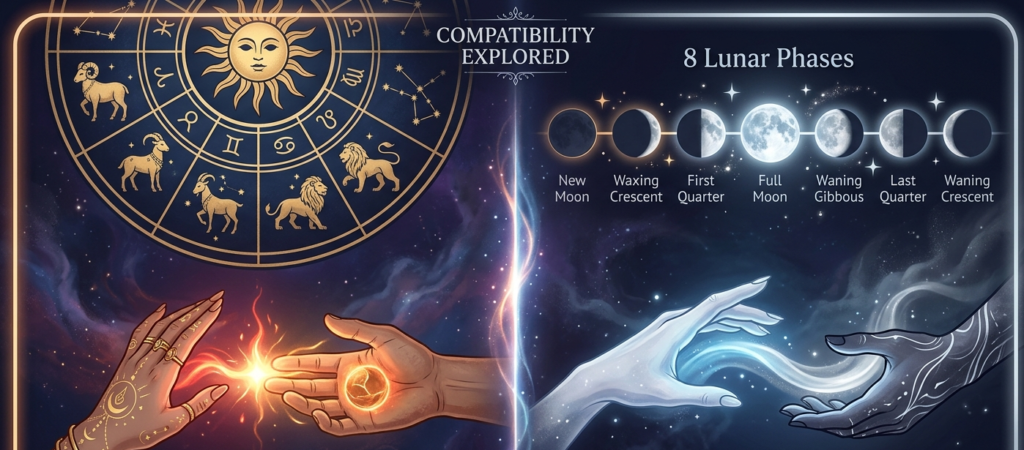
Understanding Zodiac (Sun Sign) Compatibility
Each of the twelve zodiac signs carries its own flavour of personality, and this is where sun sign compatibility starts to make sense. Your sun signs shape core personality traits, the surface-level identity people notice first when they meet you. In astrology, this is treated as one layer of a much bigger picture — a starting point, not the full story. Two people might share strong instinctive recognition the moment they meet, almost like their creative energies naturally sync up.
Think of two friends who just click at a party without knowing anything about each other’s chart; that spark often traces back to compatible sun signs. But real relationships in astrology go deeper than that first impression. The ruler of the sign — the planet governing each zodiac sign — adds another layer, along with other personal positions in the sky at the time of birth.
A proper compatibility report doesn’t stop at comparing two sun signs side by side. It usually involves a full natal chart, layered with personal data like birth time and location, then a comparison of natal charts between two people. Astrologers sometimes go further, using the midpoint method or Davison’s method to map out a relationship as its own separate entity, almost like a third chart born from the couple itself. This approach reveals relationship compatibility and personality dynamics that a basic sun sign match could never capture. It’s worth noting that no method guarantees a perfect prediction — astrology works best as a mirror for deeper understanding, not a rulebook.
Reading a chart together can build mutual respect and deeper self-awareness, as it often reflects your own strengths and weaknesses back to you. This is really the value of astrological interpretation, it opens a window into interpersonal energy and subtle solar influences, helping two people understand how their distinct personality types interact.
Understanding Moon Phase Compatibility
A new moon phase trend has been taking over social feeds lately, and it’s got people looking at the sky in a whole new way. Instead of checking zodiac signs or moon sign placements, this moon phase compatibility test focuses purely on the visual appearance of moon shapes at the moment two people were born. Picture two friends scrolling through a video, curious to see if their birth moons ‘fit.’ That shared moment of discovery is exactly why the trend went viral. In traditional astrology, the moon phase someone is born under says a lot about the energy they carry into daily life and relationships.
While traditional astrologers track lunar cycles for emotional temperament, this viral visual test is a modern social media creation rather than an ancient practice. This sets it apart from pop astrology, which usually leans on online quizzes and surface-level personality traits instead of raw celestial position.
Still, it’s worth asking whether a viral trend can really predict relationship compatibility, or if it’s just entertainment dressed up as astrology. The truth sits somewhere in between. A proper compatibility report on moon phase soulmates looks at how two moon phases align visually, then interprets what that pairing might mean for emotional rhythm between two people.
The moon phase indicator isn’t a guarantee of romantic success, and no single placement can replace a full natal chart reading. What it can offer, though, is a starting point for self-understanding through astrology — a low-stakes way to reflect on your personal emotional patterns. That is the true appeal of the lunar soulmate trend: it is less about proving fate and more about sparking self-curiosity.
Astrology vs Lunar Phase Compatibility: Side-by-Side Comparison
| Comparison Factor | Traditional Astrology (Zodiac / Sun Signs) | Lunar Phase Compatibility |
| Core Basis | Planet & Sun positions at exact moment of birth | Illumination & shape of the Moon at birth |
| Nature of Energy | Static / Fixed: Core identity & long-term traits | Dynamic / Cyclic: Emotional rhythms & mood shifts |
| Primary Focus | Character traits, ego, & outer personality | Inner feelings, emotional timing, & instincts |
| Cycle Length | Solar year (~365 days; ~30 days per sign) | Synodic month (~29.5-day repeating cycle) |
| Methodology | Full Natal Chart, Synastry, Midpoint/Davison | Visual moon shape overlay or birth phase pairing |
| Pacing & Progression | Steady & Seasonal: Changes gradually every month with solar seasons | Fast & Dynamic: Shifts shape every few days through 8 distinct lunar phases |
| Best Used For | Long-term personality & relationship dynamics | Timing personal intentions & daily emotional alignment |
Lunar Compatibility vs Sun Sign Compatibility: Which Matters More?
When people first learn about relationships in astrology, they usually start with sun sign compatibility — checking if two individuals naturally get along based on sun signs alone. This method looks at surface-level personality traits and gives a quick sense of instinctive recognition between two people. But a real compatibility report goes deeper, pulling from a full natal chart, the ruler of the sign, and other personal positions at birth.
Tools like the midpoint method or Davison’s method even build a separate chart just for the relationship itself, showing personality dynamics that a basic sun sign match could never reveal. This is why one astrologer might tell a couple their sun sign compatibility looks rocky on paper, yet their full charts show strong mutual respect and shared creative energies underneath.
The newer moon phase compatibility test takes a completely different route. Instead of comparing full charts, it focuses on the visual shape of the moon at birth, highlighting the immediate lunar illumination present at that moment. A person’s moon phase reflects the quiet energy they carry day to day, something a sun sign alone can’t capture. So which one matters more? Neither replaces the other.
The Sun’s influence on personality shapes how someone acts and connects with others, while the moon phase shapes how they feel and process emotion underneath that surface. Real astrological compatibility looks at both together, since true deeper understanding between two people rarely comes from just one placement in the sky.
How to Use Both Together for Maximum Insight
The real value shows up when you stop picking one method over the other and start layering sun sign compatibility with moon phase compatibility instead. Start with the basics: compare sun signs to get a quick read on how two people express themselves and clash or click on the surface. Then pull up both natal charts and look at where each moon sign sits, since this reveals the emotional undercurrent that a sun sign alone can’t show.
For example, if a couple has fiery, headstrong sun signs that seem like a rocky match at first glance — but their moons turn out to be in gentle, compatible water signs. That contrast often explains why some couples argue over small things yet still feel deeply understood by each other underneath it all. This layered approach is exactly what a proper compatibility report is built to capture, offering a complete view of how two distinct personalities interact.
From there, going deeper with methods like the midpoint method or Davison’s method can sharpen the picture even further, especially for couples who want more than a surface-level answer. These techniques generate a chart for the relationship itself, blending both people’s personal positions into one combined snapshot. It’s worth being honest here — no combination of tools removes the need for communication, and no chart can predict how two people will actually choose to treat each other day to day. Astrology works best as a mirror, not a verdict. Used together, sun sign and moon phase readings offer real deeper understanding, giving couples language to talk about their differences instead of just numbers to argue over.
Conclusion & Key Takeaways
Sun signs and moon phases each tell a different part of the same story. One shows how you show up in the world, the other shows what’s happening underneath. Neither one alone gives the full picture, but read together, they offer real insight into how two people connect, clash, and grow. At the end of the day, no chart replaces honest conversation — astrology just gives you better questions to ask.
Try our free Moon Phase Compatibility Calculator to uncover your shared lunar connection, or generate a full relationship breakdown with our Synastry Chart Calculator.
Moon Phase vs Zodiac Sign Difference-(FAQs)
What moon phase is best for compatibility?
There’s no single “best” phase — compatibility depends on how two moon phases relate to each other, not which one is objectively stronger. A waxing moon paired with a waning moon, for example, can create balance rather than conflict. What matters more is the emotional pattern each phase represents, not a ranking of good versus bad.
Do moon phases affect compatibility?
Yes, in the sense that your moon phase reflects the emotional energy you were born into, which shapes how you process feelings in relationships. It’s not a scientifically proven mechanism, but it’s a long-standing astrological pattern many people find useful for self-reflection. Think of it as one layer of insight, not a fixed rule.
Which Moon sign is most compatible?
Water and earth moon signs (like Cancer, Pisces, Taurus, and Virgo) are often described as naturally compatible due to shared emotional pacing. That said, compatibility isn’t only about matching signs — a full chart comparison usually tells a more accurate story than moon sign alone.
How do I find my Moon Phase?
You’ll need your exact birth date, time, and location, since the moon shifts phase every few days. A moon phase compatibility calculator or astrologer can pull this from your birth data in seconds. Without an accurate birth time, the result may be off by a day or more.
Is Moon Phase compatibility more important than Sun Sign compatibility?
Neither outweighs the other — they measure different things. Sun sign shows how you express yourself outwardly, while moon phase reveals your emotional undercurrent. Real compatibility insight comes from looking at both together, not choosing one over the other.
