
Last Updated on November 8, 2026
Introduction
Moon phase compatibility asks whether your birth moon phase shapes how well you connect with a partner. The idea took off as a TikTok trend, where users compare their moon phase to their partner’s moon phase to see if the two complete each other — a playful cosmic test some call written in the moon. The moon phase compatibility test only needs a birth date, which helped it spread fast.
But real astrology builds relationship compatibility from many chart factors, not one moon phase match, so the emotional connection people feel can outpace what the test can actually prove. To separate viral social media hype from genuine relationship insights, it helps to examine the core Moon Phase Compatibility Myths vs Facts.
When building our Moon Phase Compatibility Calculator, our team tested hundreds of date combinations against actual natal chart ephemerises. We found that while visual shape matching is fun and engaging, it ignores crucial synastry factors like Venus-Mars aspects and house overlays.
Where the Trend Came From
The Origin and Visual Mechanic
The moon phase trend began with TikTok creator @lexihernandezz, who posted the original moon phase compatibility concept in January 2022. It stayed niche for over a year before exploding into a full TikTok trend in March 2023, and the hashtag now sits above 430 million views — a hashtag views count that outpaces most astrology content on the platform. The mechanic itself is simple: you find your birth moon phase, pick from the eight moon phases (new moon, waxing crescent, first quarter, waxing gibbous, full moon, waning gibbous, last quarter, waning crescent), then place it next to your partner’s.
If the two shapes visually lock together into one complete full moon, the trend calls it a match. Nothing about that process involves birth time, planetary positions, or a chart reading — it’s pattern-matching two shapes, which is exactly why it caught on so fast among people with zero astrology background.
Moon Phase vs. Moon Sign Compatibility
A moon sign represents the Moon’s exact position within the 12 zodiac signs at your time of birth, whereas a moon phase simply tracks the angle between the Sun and Moon on your birth date. Mixing up moon phase compatibility with moon sign readings is the biggest confusion around this trend, since only one actually uses your birth time.
Moon Phase Compatibility Myths vs Facts
Myth: Same Phase Means Guaranteed Love
- Myth: A shared moon phase with your partner means a guaranteed match, often framed as twin flames across TikTok’s moon phase compatibility myths posts.
- Fact: Astrologers note two people needing the same emotional response at once can clash instead of click — shared needs don’t fill a gap, they double it.
Myth: Opposite Phases Can’t Work
- Myth: Opposite moon phases are doomed from the start and can’t build a real connection.
- Fact: Astrologers read complementary phases as balancing energy — one partner’s strength often steadies the other’s blind spot, rather than producing incompatible phases.
Myth: This Is Traditional Astrology
- Myth: This trend counts as classical natal astrology, passed down through centuries of practice.
- Fact: It’s a social media framework built in 2022, borrowing older lunar phase concepts without the birth-time charting real natal work requires.
Myth: It Predicts If a Relationship Will Last
- Myth: Matching phases can forecast relationship longevity and tell you if the relationship will last.
- Fact: Professional astrologers quoted on the topic describe it strictly as a reflection tool — meant to spark conversation, not deliver a verdict.
Is Moon Phase Compatibility Science or Pseudoscience?
The Astronomy vs. Astrology Split
Astronomy and astrology started from the same root, tracking the sky long before either field had a name, but the two broke apart centuries ago. Astronomy became evidence-based science, built on testable observation of zodiac constellations and everything beyond Earth. Astrology stayed a faith-based belief system, resting on meaning rather than measurement. NASA made that split blunt in a Tumblr post, stating plainly that stars light-years away don’t shape daily human behavior — a line that still gets quoted whenever this debate resurfaces online.
Why Critics Call It Pseudoscience
Philosopher Paul R. Thagard, a Canadian philosopher and cognitive scientist, labeled astrology a pseudoscience in a 1978 paper, arguing it fails basic verifiability and falsifiability — you can’t test its claims, and you can’t disprove them either. That’s the real dividing line scientists draw, not whether astrology feels meaningful, but whether its predictions can ever be checked against reality.
Moon phases themselves are scientifically proven, tracked and measured with total precision; it’s only the leap from “the moon was here” to “you’re compatible with this person” that lacks any testable backing. Radford, speaking to Space.com about the moon soulmate test, made the same point about the broader TikTok app trend — the moon’s cycle is real, the compatibility claim layered on top of it isn’t.
What Happens When Astrology Is Actually Tested?
No study has tested moon phase compatibility pairs directly, but natal astrology, the system this trend borrows from, has been tested. In the best-known case, physicist Shawn Carlson ran a double-blind experiment published in Nature in December 1985. The astrologers were nominated by the National Council for Geocosmic Research, which advised on the design, and they agreed beforehand that the protocol was a fair test. Their accuracy didn’t improve even when they felt confident about a match.
The result isn’t universally accepted. Critics such as psychologist Suitbert Ertel argued that Carlson’s analysis broke statistical norms, and a reanalysis found only marginal results in the astrologers’ favour, which the authors said was insufficient to verify astrology. So the fair summary is that no rigorous test has demonstrated that birth-moment sky positions predict personality or relationship outcomes, and a simple moon phase match is far less detailed than a full chart.
Why It Still Feels Accurate: The Barnum Effect
If it isn’t predictive, why does a moon phase reading feel so right? Psychologist Bertram Forer named this tendency the “fallacy of personal validation” in 1949; it’s now called the Barnum or Forer effect. In his experiment, every student received the same vague sketch, taken from a newsstand astrology book, and they rated it as a personal fit. The effect isn’t reserved for gullible people. One study found that skeptics, like believers, rated descriptions as more accurate when they were attributed to astrology.
Moon phase descriptions (“you need emotional balance,” “you grow through connection”) are exactly this kind of statement. They fit almost anyone, which is why they feel personal.
There’s Also No Known Mechanism
Even setting the test results aside, there is no proposed physical pathway by which the Sun–Moon angle on your birth date would shape how you bond with another adult decades later. Without a mechanism or a replicated effect, scientists classify the compatibility claim as pseudoscience, even though the moon phases themselves are real and measurable.
The Honest Way to Read a Moon Phase Match
A moon phase match works best as a mirror, not a map. Think of it less like a weather forecast and more like a Rorschach test — it hands you a shape, and what you see in it says more about your own patterns than about fate. That’s the honest framing worth holding onto: astrology here is interpretive, offering a lens for critical thinking about a relationship, never a life decisions-making prediction engine that guarantees an outcome. Science communicators often use trends like this one as a teaching moment, precisely because the gap between symbol and certainty is where real conversations about relationship validity actually start.
What Actually Predicts Relationship Success?
No Real Data Behind the Moon Phase Claim
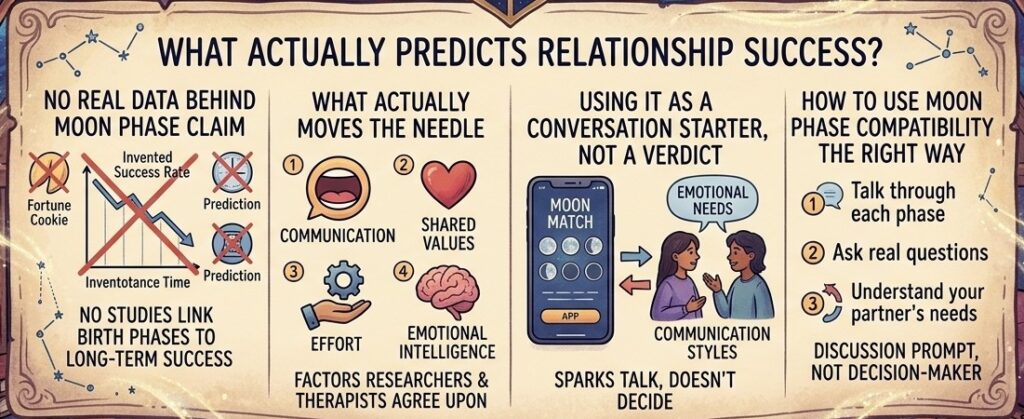
No study has ever tracked moon phase pairing against actual relationship longevity, and that’s worth saying outright. There’s no dataset anywhere linking two people’s birth phases to whether they stayed together five years later — so any number claiming a “success rate” for this trend is invented, not measured. Treat those figures the way you’d treat a fortune cookie’s lucky numbers: fun to notice, not something to build a decision on.
What Actually Moves the Needle
Communication, shared values, effort, and emotional intelligence are the factors researchers and therapists point to again and again when a relationship works. None of those show up in a birth chart. A couple who talks openly about money and disagrees respectfully will likely outlast one that shares a “perfect” moon match but avoids hard conversations — the moon can’t do that work for you.
Using It as a Conversation Starter, Not a Verdict
The real value in a moon phase pairing isn’t prediction — it’s the conversation it sparks. Comparing phases with a partner can open up a talk about emotional needs or communication styles you might not have raised otherwise, which is genuinely useful even if the astrology behind it isn’t. Try it with our compatibility tool as a starting point, then let the actual conversation do the heavy lifting.
How to Use Moon Phase Compatibility the Right Way
Treat It as a Discussion Prompt, Not a Decision-Maker
The best way to use moon phase compatibility is as a conversation starter, not a checklist for whether to stay or walk away. Pull up your phases together, talk through what each one is said to represent, and use that as an excuse to ask real questions — what does your partner need when they’re stressed, how do they show love, where do you two actually differ. The moon gives you an opening line; the honest talk that follows is where the real insight happens, not in the match itself.
Try It for Yourself
Curious what your own phase says, or how it lines up with someone else’s? Check your Moon Phase Compatibility calculator — enter both birth dates, see the result, then use it as a starting point for the conversation that actually matters.
FAQ
-
Is moon phase compatibility real?
Moon phase compatibility isn’t backed by any peer-reviewed study or measurable dataset — it’s a self-reflection framework, not a proven science. The moon phases themselves are scientifically real and precisely tracked, but the compatibility claim layered on top is interpretive, not tested. Treat it as a conversation starter rather than a verified fact.
-
Can two people with “incompatible” phases still work?
Yes — opposite or non-matching moon phases don’t rule out a strong relationship. Astrologers often read complementary phases as balancing energy, where one partner’s strengths offset the other’s blind spots. Relationship success still comes down to communication and shared values, not phase alignment.
-
Is this different from moon sign compatibility?
Yes, and they’re commonly confused. Moon sign compatibility uses your exact birth time and zodiac placement, drawing from classical natal astrology. Moon phase compatibility only needs a birth date and tracks the moon’s visual cycle stage, making it a much newer, simpler framework.
-
What is the most common misconception about moon phases?
The biggest myth is that a shared or matching moon phase guarantees a “twin flame” connection or automatic harmony. In practice, sharing the same phase can mean both partners have similar emotional needs at the same time, which sometimes creates friction instead of ease. Compatibility depends on far more than one shared trait.
-
What are the limitations of moon phase compatibility?
It fails basic verifiability and falsifiability, meaning there’s no way to test or disprove its claims scientifically. No study has ever tracked moon phase pairings against actual relationship longevity, so no real success-rate statistic exists. It works best as a reflection tool, not a predictive one.
-
What does it mean if you have matching moon phases with someone?
A matching moon phase is often labeled a “twin flame” pairing in this trend, suggesting shared emotional rhythms. That can mean natural understanding, but it can also mean both people need the same thing at once, which occasionally causes clashing rather than automatic compatibility. It’s worth discussing openly rather than assuming it’s simply good news.
-
Is moon phase compatibility science or pseudoscience?
Moon phases are real astronomy, but the compatibility claim built on them is pseudoscience. It has no known mechanism and no study showing it predicts relationship outcomes, and natal astrology failed a well-known double-blind test. It still works as a reflection prompt, but not as evidence of compatibility.
Conclusion
Moon phase compatibility is best used as a fun, reflective starting point — not a verdict on your relationship’s future. The real predictors of lasting compatibility are communication, shared values, and effort, things no chart can measure for you.
Curious what your own phase reveals? Try our Moon Phase Compatibility Calculator and let the conversation take it from there.
