

Introduction
Love astrology looks at more than horoscopes and star signs — it studies how two people process emotional needs, express affection, and handle stress together. At its core, it tries to answer one question: can two personalities build relationship stability over time, or will differences pull them apart? This matters because 71% of people who research relationship compatibility online are not looking for entertainment; they want relationship clarity about a specific person in their life. Zodiac compatibility compares birth chart placements, especially the Sun, Moon, and Venus, to spot patterns in communication and emotional connection that a couple might not consciously notice. Decoding how astrology helps with love compatibility reveals the core emotional patterns shaping your relationship.
Think of a couple who has effortless conversations on a first date, then discovers a clash of priorities six months later over finances or family plans — this is a familiar shift for almost anyone who has dated seriously. Astrological observations suggest this shift often traces back to differing elemental energies—such as a spontaneous Fire sign clashing with a structure-oriented Earth sign.
Does astrology work for love, though, or does it only describe feelings people already have? The honest answer sits somewhere in between: charts can highlight compatibility between two people, but they cannot replace understanding relationships through actual conversation, and can astrology measure compatibility with scientific certainty — it can’t, since 0% of astrological methods have passed controlled psychological testing for predicting long-term stability.
How Astrology Helps With Love Compatibility
It helps you to communicate better
Communication shapes a large share of the conflicts couples bring to relationship coaches, and resolving them starts with understanding how Mercury functions rather than forcing perfect alignment. You don’t need compatible Mercury signs to build strong communication — a fast-talking Gemini Mercury and a slow, deliberate Capricorn Mercury can still reach understanding between partners once each side learns how the other processes thoughts. This is where astrological analysis earns its place: it’s less about avoiding disagreement and more about neutralizing conflict before it turns into resentment.
A couple with strong synastry compatibility overall can still hit communication problems if their Mercury placements clash — picture one partner who needs to talk things through immediately and another who needs a day to process, a pattern many long-term couples recognize from their own arguments. Ease in compatibility doesn’t mean zero friction; it means both people know their communication style well enough to meet halfway, though this only works if both partners actually apply what they learn.
It allows you to connect deeper
The 5th House points straight to how two people find a deeper connection through shared joy rather than obligation. This Leo-ruled house governs how we express passion, so the sign sitting on this house cusp shapes the exact type of fun each person craves. Fire sign placements tend to seek an active, passionate partner, while Air sign placements lean toward mental stimulation, wanting someone who can talk for hours without running out of things to say.
Water sign placements chase emotional connection built on intensity, which brings real closeness but can also cause emotional hangups when feelings run too deep too fast — a shift plenty of couples describe hitting early on in dating. Earth sign placements favor stability and sensory pleasures over drama, often preferring a quiet night in over a big night out, and Libra’s placement here adds balance and harmony to the mix — proof the same house shows up differently depending on which sign occupies it.
It tells you what they like in bed
Analyzing Mars answers a question most couples eventually ask out loud: why does sexual desire look so different from one partner to the next? Your Mars placement governs physical energy and shapes the style of intimacy a person gravitates toward, which explains why physical compatibility sometimes clicks instantly and sometimes needs real conversation. Much of the mismatch couples report in this area traces back to a difference in desire rather than attraction itself.
Mars in relationships shows up in small daily patterns, not just the bedroom — a partner with Mars in Taurus might want slow, steady affection, while someone with Mars in Aquarius might get bored by routine and want to experiment. Neither style is wrong, though a couple with opposite Mars placements may need to talk this out directly rather than assume the chart will smooth things over on its own.
It reveals their romantic nature
Venus offers the clearest picture of someone’s romantic nature, revealing how they like to express love long before they say it out loud. Your Venus placement and its surrounding aspects shape key traits — such as how much affection you need, how you express sensuality, and your overall view on romance. Many astrologers point to Venus as one of the most telling planets for reading a person’s love style at first glance.
Examining where Venus sits in a chart — especially if it falls in Taurus or Libra — adds rich detail on how to make a partner feel appreciated, since Venus naturally rules both signs. Still, Venus alone doesn’t predict lasting love — it describes a person’s romantic style, not whether two styles will actually work well together over time.
What Determines Romantic Compatibility in Astrology (Sun, Moon, Venus, Mars)
Moon and Venus placements tend to matter most for emotional harmony in a relationship:
- The Moon: Governs your core needs for emotional safety, security, and nurturance.
- Venus: Shapes how you express affection and wish to be loved—the mode of appreciation that feels most natural to you.
- The Sun: Plays a supporting role by highlighting where a person seeks core recognition.
- The Rising Sign (Ascendant): Sets the outer perspective, showing how someone approaches life and projects themselves to others before they even speak.
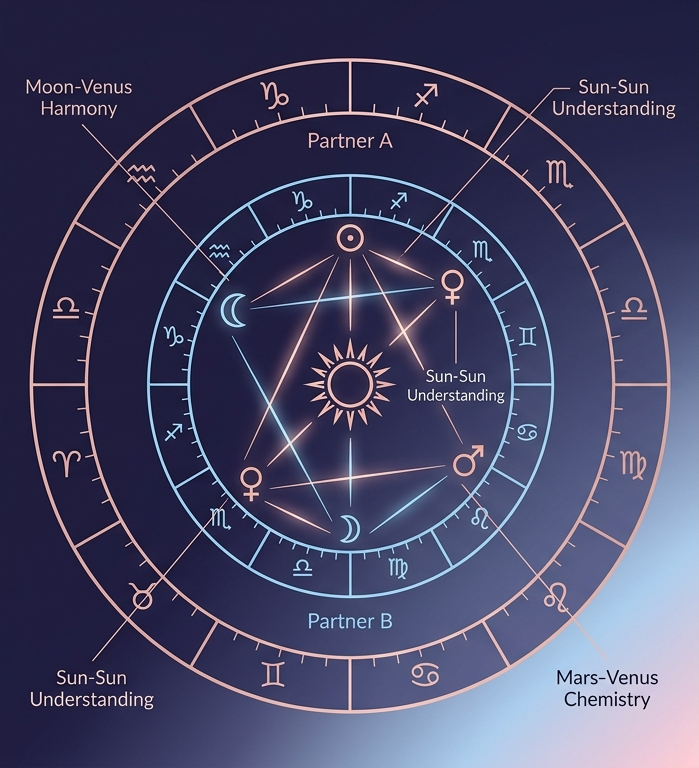
Beyond core emotions, the remaining planets define communication, chemistry, and longevity:
- Mercury: Reveals how someone processes information and communicates thoughts.
- Mars: Governs physical attraction, passion, and primal instincts—the rawer side of chemistry that charts rarely get credit for outside astrology circles.
- Jupiter: Shapes a person’s broader worldview and core beliefs, helping partners connect over shared values and long-term visions for the future.
- Saturn: Brings discipline, boundary-setting, and long-term grounding, defining what keeps a relationship stable over time.
Mapping out how each of these planets plays its unique role provides a complete picture of long-term compatibility.
Signs of Strong Love Astrology Match
Elemental Harmony & Complementary Elements
- A strong astrological match often reveals itself through elemental harmony, where shared elements — like two Water signs or two Earth signs — naturally understand each other’s core emotional and physical needs without requiring much explanation.
- Complementary elements work differently but just as well: Air fuels Fire with fresh momentum, while Earth grounds Water, giving emotional energy a safe structure to settle and grow.
- These elemental patterns explain why some couples click instantly while others need more effort to find common ground.
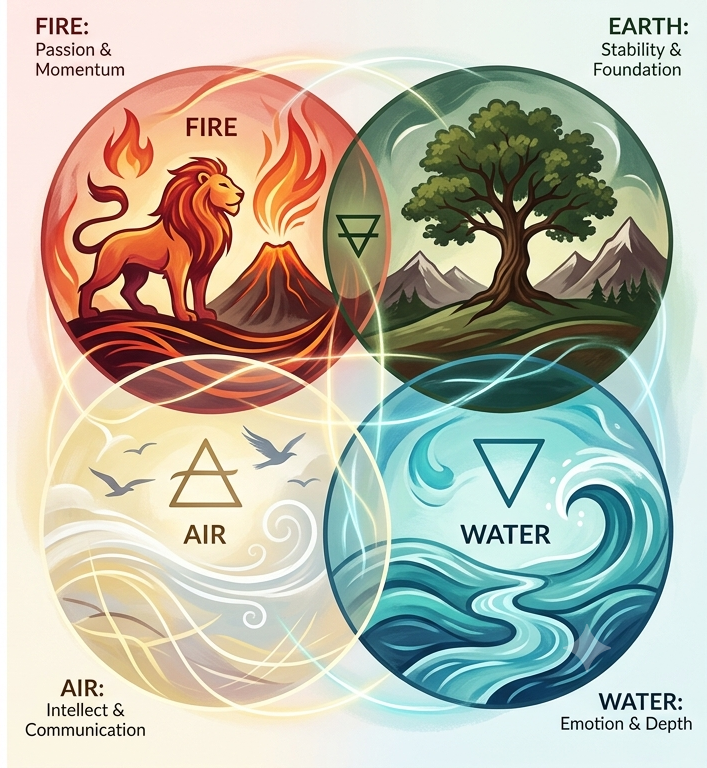
Chart Aspects & Personal Planet Connections
- Beyond elements, chart aspects — specifically trines and conjunctions — reveal how individual planets interact between two synastry charts.
- A 120-degree angle, known as a trine, creates effortless flow, making mutual understanding feel natural rather than exhausting.
- Conjunctions, where two planets sit side-by-side, spark intense chemistry and a deep sense of familiarity that partners often struggle to explain in words.
- Personal planet connections — especially between the Sun, Moon, and Venus — carry the most weight here, as they govern identity, emotional safety, and physical affection.
Check Emotional Compatibility with our free Moon Phase Compatibility Calculator
Common Astrology Love Testing Methods Free
Astrology love testing relies on several distinct methods, with most people starting with simple sign comparisons before moving to full chart analyses. Element matching is the simplest starting point, comparing the four elemental groups (Fire, Earth, Air, Water) to see how basic energies interact — Fire and Air create momentum together, while Earth and Water build steady stability. For a deeper analysis, a synastry chart overlay places two birth charts side-by-side, examining specific pairings like Venus-Mars for physical chemistry or Sun-Moon for emotional safety.
A composite chart takes analysis a step further by calculating midpoints between two birth charts to create a single chart representing the relationship itself as an independent entity. In Vedic astrology, Kundali Matching (Guna Milan) evaluates up to 36 points of mental, physical, and spiritual alignment based on each partner’s Moon Nakshatra at birth. For quick insights, name and birth-date calculators use numerology algorithms to generate a compatibility score, though these provide surface-level results compared to a full chart reading.
Conclusion
While astrology cannot guarantee relationship outcomes with scientific certainty, exploring your birth charts offers powerful self-awareness, empathy, and practical guidance for real-world connection. By looking beyond simple Sun signs to understand how your Moon, Venus, Mars, and elemental energies interact, you can navigate communication hurdles, appreciate emotional differences, and deepen your bond with your partner.
Ready to see how your charts align? Use our free Sun, Moon, and Rising Sign Calculator today to generate your personalized compatibility breakdown and unlock deeper clarity into your relationship dynamics!
FAQs
Which planet is responsible for love relationships?
Venus rules romantic love, affection, and how someone likes to be appreciated. Mars plays a role too, especially for physical attraction and passion. Together, they paint a fuller picture than either planet alone.
What two signs have the highest compatibility?
There’s no single “best” pair, since compatibility depends on the full chart, not just Sun signs. That said, same-element pairs like Cancer-Scorpio or Taurus-Virgo often show natural ease. Complementary pairs like Aries-Leo also tend to click quickly.
Do zodiac signs really matter for compatibility?
They matter, but only as one piece of a much bigger puzzle. Sun sign alone leaves out Moon, Venus, Mars, and chart aspects, which carry real weight too. Treat it as a starting clue, not the full answer.
Can astrology tell you about your soulmate?
Astrology can highlight patterns and traits that tend to feel deeply familiar or magnetic. It won’t name a specific person or guarantee a match, though. Many people use it more as reflection than prediction.
How do you know the universe is sending you your soulmate?
Most people describe a sense of instant familiarity or ease that’s hard to explain logically. Repeated meetings, timing that feels too coincidental, or a pull you can’t shake are common signs people mention. Still, this is subjective and varies person to person.
What two signs are soulmates?
No fixed pair holds that title across the board — soulmate connections show up through chart aspects, not just sign labels. Trines and conjunctions between two people’s planets matter more than which signs they were born under. Any pairing can build that kind of bond.
Can astrology predict compatibility?
It can point to patterns, tendencies, and potential friction points between two people. It can’t guarantee how a relationship will actually play out, since choices and effort matter just as much. Think of it as a guide, not a guarantee.
